
The Hidden Cost of Domestic Violence: Why Financial Empowerment Matters
EMPOWERMENT LEADS TO INDEPENDENCE
At SAFE this May, we're talking about something crucial: the financial barriers that keep survivors from leaving unsafe situations.
May is Mental Health Awareness Month, and at SAFE, we know that mental health and financial stability are deeply interconnected, especially for survivors of domestic violence.
When we think about domestic violence, we often picture physical harm. But there's another form of abuse that's just as damaging and far more invisible: financial abuse. And it's one of the most powerful tools abusers use to maintain control.
This May, as we focus on how empowerment leads to independence, we're pulling back the curtain on the financial realities survivors face and why addressing these barriers is crucial to breaking the cycle of violence.
The Reality of Financial Abuse
According to the National Network to End Domestic Violence, financial abuse occurs in nearly 99% of domestic violence cases. Let that sink in. Almost every survivor we serve has experienced some form of financial control or manipulation.
What Financial Abuse Looks Like
Complete financial control: The abuser manages all money, gives "allowances," or requires receipts for every purchase
Credit destruction: Opening credit cards or loans in the survivor's name without permission, then destroying their credit score
Employment sabotage: Preventing the survivor from working, showing up at their job to cause scenes, or forcing them to quit
Hidden assets: Keeping financial information secret so the survivor doesn't know what resources exist
Economic dependence: Creating a situation where the survivor has no access to money, no job skills, and no financial independence
The goal? Make leaving financially impossible.
The True Cost of "Just Leaving"
"Why doesn't she just leave?"
If we had a dollar for every time we heard that question, we could fund our entire financial assistance program.
Here's why it's not that simple.
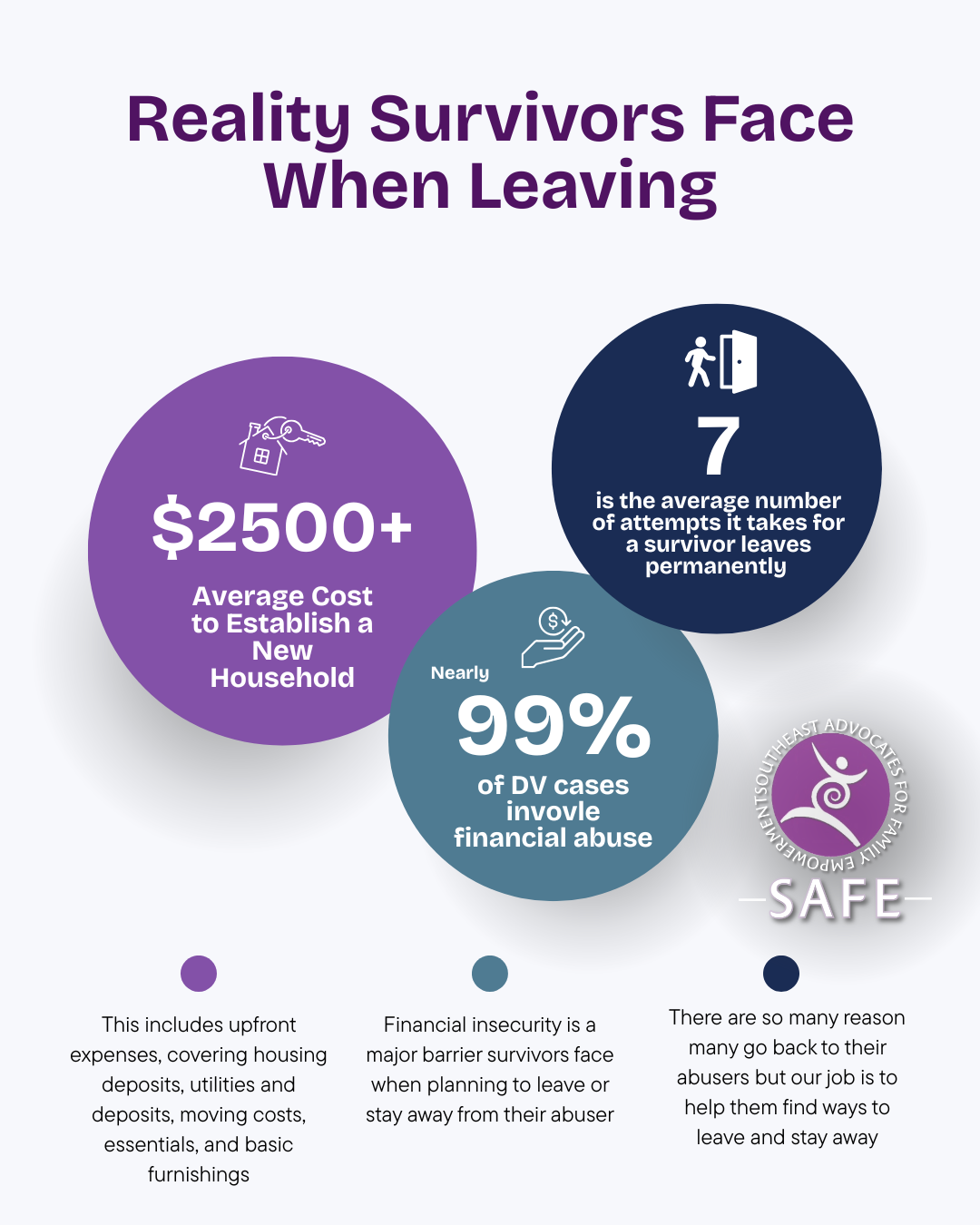
The Financial Reality of Leaving
Did you know?
It costs an average of $2,500+ to establish a new household (deposits, utilities, basic furnishings)Financial barriers aren't just numbers; they're why safety feels impossible.
SAFE provides emergency financial assistance because we know: you can't rebuild your life when you're worried about keeping the lights on.
Immediate Costs of Leaving
First month's rent: $800-$1,200 Security deposit: $800-$1,200 Utility deposits (electric, water, gas): $300-$500 Basic furniture and household items: $500-$1,000 Transportation: Variable
Total estimated cost to leave: $2,500-$4,000
For someone who's been prevented from working, had their credit destroyed, and been controlled financially for years, where does that money come from?
It doesn't. And that's exactly why they stay.
The Mental Health Connection
May is Mental Health Awareness Month, and the intersection of financial stress and mental health cannot be ignored, especially for survivors.
How Financial Abuse Affects Mental Health
Research shows that financial stress:
Increases anxiety and depression
Exacerbates PTSD symptoms
Interferes with trauma recovery
Creates chronic activation of stress hormones
Impacts physical health
For survivors, financial abuse creates a particular kind of trauma. It's not just stress about money; it's the manipulation, control, and intentional destruction of your financial future by someone who claims to love you.
The Specific Psychological Patterns of Financial Abuse
Hypervigilance around money: Every purchase creates anxiety
Difficulty making financial decisions: Years of punishment for "wrong" choices creates paralysis
Shame about financial situations: Internalized blame for abuse they didn't cause
Fear of financial autonomy: "What if I fail? What if I can't do it?"
Mistrust of institutions: Banks, credit, and systems feel dangerous after years of control
You can't fully heal mentally while drowning financially. And you can't build financial stability while battling untreated trauma.
This is why SAFE's approach addresses both.
How SAFE Creates Financial Empowerment
At SAFE, we understand that true independence requires more than a safe place to stay for a few nights. It requires comprehensive support that addresses the real, practical barriers survivors face.
1. Emergency Financial Assistance
We provide help with bills and financial support for securing new housing. This isn't charity, it's removing the barrier between danger and safety.
When we cover a security deposit or help with utilities, we're saying: "You don't have to choose between safety and survival."
What this covers:
First month's rent for new housing
Security deposits
Utility deposits (electric, water, gas)
Basic household necessities
This immediate stabilization means survivors can ask themselves "Where will I sleep tonight?" and actually have an answer. A safe answer. An answer that doesn't require going back.
2. Financial Literacy Education
We've partnered with BankPlus to offer a budget class.
Why does this matter? Because understanding how to budget opens doors to:
not having more month than money
making sure essentials don’t get shut off
Financial confidence and autonomy
For survivors whose finances were destroyed through financial abuse, this education is transformative.
Common questions survivors ask us:
"How do I budget when I don’t make enough money to pay everything?"
"What's a credit score and why does it matter?"
"How do I budget when I've never controlled money before?"
"How do I build savings when I'm barely covering expenses?"
Knowledge is power. Financial knowledge is independence.
3. Employment Connections
We connect survivors with Geaux Jobs for resume help and interview preparation.
Employment means more than income; it means dignity, independence, and options.
What survivors receive:
Professional resume development
Interview preparation and practice
Job search strategies
Support navigating application processes
Connection to employers who understand their situation
We're also actively building partnerships with local businesses for job placement opportunities. If your business wants to be part of this network, contact us at info@safelouisiana.org.
The challenge survivors face: Years of employment sabotage, gaps in work history, and lack of recent references make job hunting incredibly difficult. Our support helps survivors explain these gaps honestly, rebuild confidence, and connect with employers who understand.
4. Long-Term Support Systems
While we're still building out comprehensive long-term programs, our goal is clear: move survivors from crisis to stability to independence.
That means continued education, resource connection, and community support well beyond the immediate crisis.
What we're working toward:
Expanded financial literacy programs
Longer-term financial coaching
Partnerships with more employers for guaranteed job placements
Savings programs and matched savings initiatives
Entrepreneurship support for survivors with business ideas
Because survivors don't just need help surviving today, they need support building a future worth living.
Hands creating a heart, describing how SAFE helps survivors of domestic violence create stability and rebuild their lives after leaving
The Journey from Survival to Stability to Independence
Financial recovery doesn't happen overnight. It's a journey with distinct phases:
Phase One: Crisis to Safety (Month 1)
The questions are urgent:
"Where will I sleep tonight?"
"How will I feed my kids?"
"What about school tomorrow?"
What SAFE provides: Emergency financial assistance that creates immediate stability, a small apartment, lights that turn on, water that runs, and a door with a lock.
The milestone: A safe place where fear doesn't live.
Phase Two: Building Foundation (Months 2-3)
The harsh reality: Survivors need income, but employment sabotage has created real barriers.
What SAFE provides: Connection to Geaux Jobs for resume help, interview prep, and job placement support.
The milestone: First paycheck. Income earned. The beginning of financial autonomy.
Phase Three: Understanding and Rebuilding (Months 3-6)
The barrier emerges: Understanding the financial damage and learning how to rebuild.
What SAFE provides: Credit understanding classes through BankPlus that teach rights, dispute processes, and rebuilding strategies.
The milestone: Learning that the debt isn't all their responsibility. Discovering that credit can be rebuilt. Creating a plan for their financial future.
Phase Four: Stability Building (Months 4-12)
What stability looks like:
Rent paid on time (building positive rental history)
Bills managed (utilities, phone, basic needs)
Work schedule consistent (building employment history)
Children settled (same school, routines, friends)
Credit slowly improving (disputing fraudulent accounts, making payments)
Small savings beginning (even $20 makes a difference)
Mental health improving (therapy, healing, hope)
The milestone: The moment survivors start to believe: "I can actually do this."
Phase Five: True Independence (Beyond One Year)
True independence isn't measured in months—it's measured in milestones:
Personal milestones:
Signing a lease renewal, choosing to stay because it's home, not because you have no choice
Handling a financial emergency without panic, the car breaks down, but you have a plan
Teaching your children about healthy money management, breaking generational patterns
Making a purchase without fear, buying something you want, not just need
Planning for the future, thinking beyond survival to actual goals
Community milestones:
Becoming a volunteer or advocate, giving back from a place of healing
Mentoring other survivors, your story becomes someone else's hope
Financial contributions to causes you care about, even small amounts matter
Engaging in community events
Living openly, safely, joyfully, is the ultimate victory
The ROI of Financial Empowerment
Let's talk investment, because supporting survivors' financial empowerment isn't just compassionate, it's smart community investment.
When You Invest $500 in Rent Assistance, You Create:
Stable housing = Children stay in the same school Safe address = Ability to apply for jobs Consistent utilities = Basic needs met, homework completed No eviction = Credit stays intact Mental breathing room = Healing can begin
This Mental Health Awareness Month, we explored how financial empowerment creates lasting change for survivors.
Survivors don't just need help surviving today. They need support in building a future worth living.
That's what SAFE does. That's what empowerment creates. That's what independence looks like.
The Long-Term Community Impact:
Employed survivors become tax-paying community members
Stable children achieve better educational outcomes
Broken cycles mean the next generation grows up violence-free
Empowered individuals become community volunteers, advocates, and leaders
This is why financial institutions, banks, and credit unions should care. This is why business leaders should step up.
You're not funding charity, you're investing in workforce development, economic stability, community safety, and generational change.
Short-term aid creates long-term outcomes.
What Independence Actually Looks Like
Independence for a survivor isn't abstract. It's concrete and beautiful:
✓ Signing a lease in your own name ✓ Opening a bank account only you control ✓ Receiving your first paycheck from a job you chose ✓ Making financial decisions without fear or manipulation ✓ Planning a future you actually want ✓ Teaching your children healthy relationships with money ✓ Building credit, savings, and stability ✓ Living without looking over your shoulder
This is what SAFE creates. This is what empowerment leads to. This is what your support makes possible.
How You Can Help
Financial Institutions & Banks:
Partner with SAFE to provide financial literacy workshops, credit counseling, or sponsor our programs. Let's work together to remove financial barriers.
Contact us:info@safelouisiana.org
Businesses:
Offer job placement opportunities for survivors
Sponsor our Purple Ribbon Campaign
Become a table sponsor at our Mother-Daughter Tea on July 25th
Join our employer network committed to supporting survivors
Contact us:info@safelouisiana.org
Community Members:
Donate to our financial assistance fund
Volunteer your professional skills (accounting, HR, finance)
Share our resources
Wear purple or display our Purple Ribbon Initiative yard sign during Domestic Violence Awareness Month (October)
Understand that financial empowerment is survivor empowerment
Donate:www.safelouisiana.org/donate
Survivors:
If you're reading this and feeling trapped by financial barriers: independence is possible. We're here to help you build it.
Call us: 985-542-8384
What Your Donation Funds
One-Time Donations:
$100 - Can cover utility deposits for a survivor's new apartment $250 - Can provide a month of financial literacy classes for multiple survivors $500 - Can fund emergency rent assistance, removing the barrier between danger and safety $1,000 - Can support comprehensive employment preparation (resume help, interview clothing, job coaching) for multiple survivors
Monthly Giving:
$50/month ($600/year) - can provide ongoing financial literacy education $100/month ($1,200/year) - can fund emergency financial assistance for multiple families $250/month ($3,000/year) - can support the full spectrum of financial empowerment services (emergency aid, education, employment support)
Become a monthly donor and provide the sustained support that moves survivors from crisis to true independence.
The Bottom Line
Safety isn't just escape; it's stability.
Empowerment isn't just feeling strong; it's having resources.
Independence isn't just leaving; it's rebuilding a life worth living.
At SAFE, we're committed to addressing the financial barriers that keep survivors trapped. Because everyone deserves to live violence-free, financially stable, and truly independent.
Help us make that possible.
Get Help or Get Involved
SAFE 24/7 Crisis Hotline: 985-542-8384
Donate Today:www.safelouisiana.org/donate Fund emergency financial assistance, financial literacy education, and employment support
Partner With Us:info@safelouisiana.org Financial institutions, banks, and businesses—let's work together
Follow Us: Facebook & Instagram: @SAFEsupport
Upcoming Event:Mother-Daughter Tea - July 25th Celebrate empowerment and support SAFE's work
If you or someone you know is experiencing financial abuse or domestic violence, please reach out. You deserve safety. You deserve stability. You deserve independence.
National Domestic Violence Hotline: 1-800-799-7233 (SAFE)
Louisiana Coalition Against Domestic Violence: 1-888-411-1333
SAFE Crisis Line: 985-542-8384
SAFE is a 501(c)(3) nonprofit organization. All donations are tax-deductible.
In honor of Mental Health Awareness Month, help us address both the financial and emotional barriers that keep survivors trapped.
Because you can't fully heal mentally while drowning financially, and everyone deserves both mental health and financial stability.