
What Every Community Member Needs to Know Before October: A Guide to Supporting Survivors
October is coming. Purple ribbons will go up. Social media will turn purple. Organizations across the country will post statistics and change their profile pictures.
And then November will arrive, and most of it will stop.
At SAFE, we want to be honest about something: awareness without action doesn't save lives. Knowledge without community doesn't support survivors. A month without a movement doesn't create lasting change.
So this September, instead of waiting for October, we want to give our community something more useful than awareness.
We want to give you tools.
Here is what every community member in Tangipahoa, Livingston, and St. Helena Parishes or in any community, needs to know and do before October arrives. These tools can be used by any community to help survivors of abuse feel comfortable opening up.
Understand What Domestic Violence Actually Is
Most people think domestic violence means physical abuse. And physical abuse is real and serious and part of the picture.
But domestic violence is also:
Emotional abuse — constant criticism, humiliation, name-calling, making someone doubt their own reality (gaslighting), destroying self-esteem through relentless psychological pressure.
Financial abuse — controlling all the money, preventing a partner from working, creating debt in their name, withholding financial information, making someone completely economically dependent.
Digital abuse — monitoring location constantly, demanding immediate responses to texts, controlling social media accounts, using technology to surveil and isolate.
Isolation — systematically cutting someone off from family, friends, and support systems until their abuser is their entire world.
Coercive control — a pattern of behavior designed to take away a survivor's freedom and autonomy, making leaving feel impossible.
When community members only recognize physical violence as abuse, survivors experiencing other forms of abuse often don't receive, or seek, the help they need. Understanding the full picture is the first step to being truly helpful.
Know Why Survivors Don't "Just Leave"
This question, asked with frustration, bewilderment, or sometimes judgment, does more harm than almost any other response to domestic violence.
The reality is that leaving an abusive relationship is one of the most dangerous things a survivor can do. Research consistently shows that the period immediately after leaving is when the risk of serious harm, including homicide, is highest. Survivors know this, often in their bones, even without the statistics.
Beyond immediate danger, the barriers to leaving are real and significant: financial dependence, no housing, fear for children's safety, isolation from support systems, psychological conditioning that has eroded self-worth, and love for a partner who can also be kind, remorseful, and loving in between abusive episodes.
Research indicates survivors leave an average of seven times before leaving permanently, according to Connections for Abused Women and their children. Each attempt is not a failure; it's information, preparation, and part of the process.
When community members understand this, they respond differently. Instead of "why don't you just leave?" they say: "I'm here for you whenever you're ready. What do you need right now?"
That response keeps doors open. The other one closes them.
Know What to Say and What Not to Say
If someone in your life confides that they're in an unsafe relationship, your response in that moment matters enormously.
Say:
"I believe you."
"This is not your fault."
"I'm here for you no matter what."
"What do you need from me right now?"
"You deserve to feel safe."
"I'm not going anywhere — I'll be here whenever you're ready."
Don't say:
"Why don't you just leave?"
"I can't believe you're still with them."
"You need to do something about this."
"What did you do to make them act like that?"
"Are you sure it's really that bad?"
Ultimatums that force them to choose between their relationship and yours
Don't pressure them to break up. Pushing too hard can make people withdraw or cling to their partner. Supportive conversations work better than ultimatums. Megan R. Holmes,Richard P. Barth,Samuel R. AymerBuilding Healthy Relationships to End Violence: Introduction…
Your job in this moment is not to fix the situation. It is to be a safe person. Share SAFE's number. Be consistent. Stay present.
Know the Warning Signs
You may not hear the words "I'm in an abusive relationship", but the signs might be visible if you know what to look for.
In someone you're close to watch for:
Sudden withdrawal from friends or family, a partner who constantly checks their location or demands immediate responses, increased secrecy around phones or social media, mood swings, anxiety, or a drop in self-esteem, loss of interest in hobbies or activities they once loved, a partner showing extreme jealousy or possessiveness, and frequent excuses made for a partner's behavior. Handspring Health
You don't need certainty before reaching out. A gentle, non-judgmental check-in, "I've noticed you seem stressed lately, and I just wanted you to know I'm here", can open a door that a survivor has been waiting for someone to push.
Know SAFE's Resources
The most practical thing you can do for someone in crisis is know how to connect them to help.
SAFE provides:
24/7 Crisis Line: 985-542-8384
Emergency shelter (up to 45 days)
Legal advocacy and court accompaniment
Financial empowerment support
Counseling and support groups
Community education and prevention programs
All services are free and confidential.
Keep this number in your phone: 985-542-8384
Share it when you can. Text it to someone who needs it. Put it in places where survivors in your life might find it.
Know How to Be Actively Part of Prevention
Supporting survivors is one side of community responsibility. Prevention is the other.
In your home: Talk to your children about healthy relationships before they start dating. Model respectful communication and conflict resolution. Use the language of consent, boundaries, and mutual respect in everyday conversations.
In your workplace: Ask whether your organization has a domestic violence policy. Find out if SAFE can come speak to your team. Make sure employees know about SAFE's resources.
In your church or community organization: Invite SAFE to present. Make resource cards available. Create a culture where people know they can speak openly and will be believed.
In your school: Advocate for healthy relationship education. Connect school counselors with SAFE. Support the conversations that teenagers need to have but often aren't having.
In your community: Wear purple in October. Display a Purple Ribbon yard sign. Add your ribbon to SAFE's Purple Ribbon Wall. Show survivors in our community, visibly, publicly, that this community stands with them.
Come to the Library This September
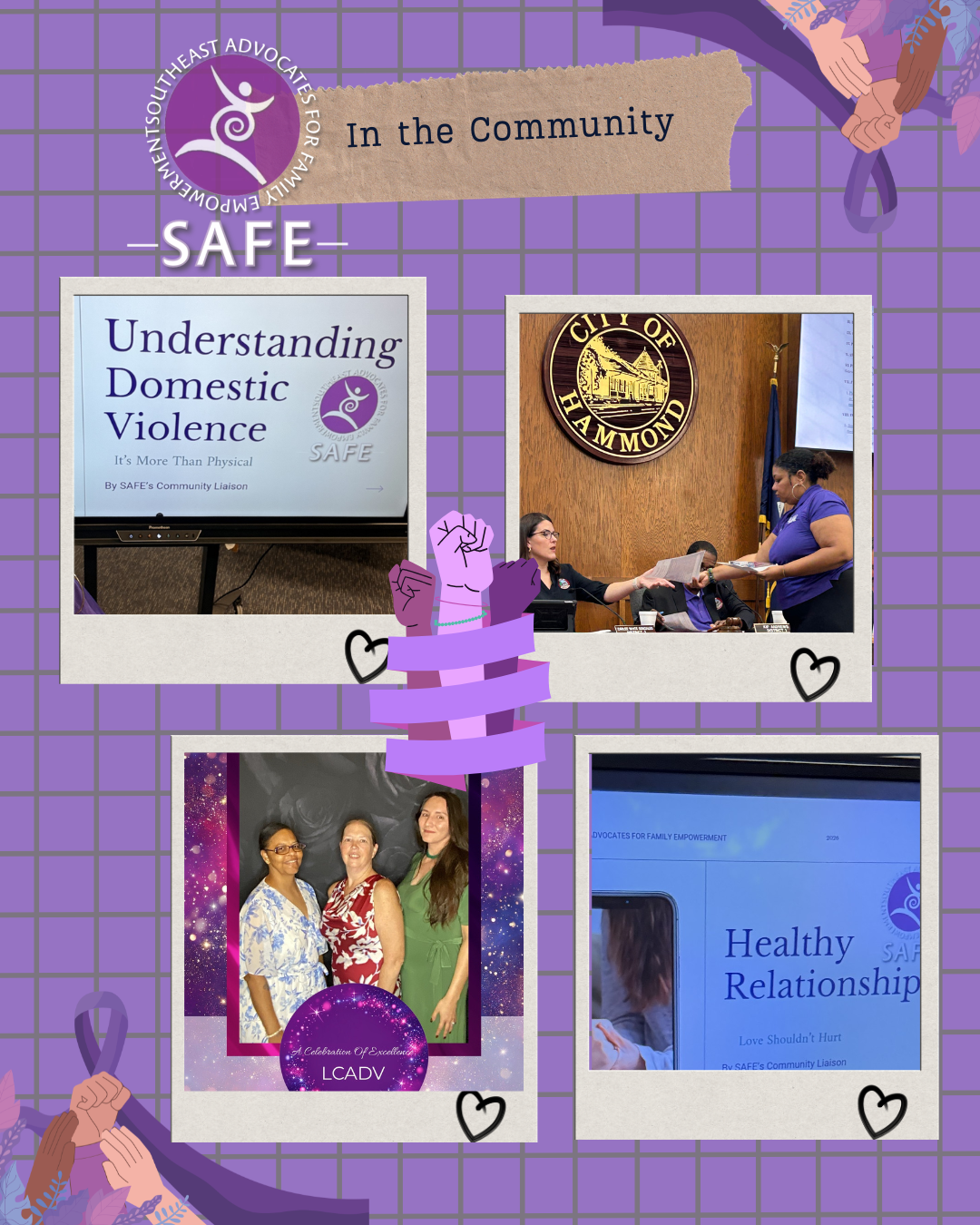
Before October arrives, SAFE's Community Liaison is bringing free educational presentations to six Tangipahoa Parish Library branches. Each one is designed to give community members exactly what this blog is giving you: knowledge, tools, and language to show up for the people around you.
September 3 — Hammond | Understanding Domestic Violence
September 8 — Independence | Understanding Domestic Violence
September 10 — Ponchatoula | Healthy Relationships
September 15 — Loranger | Healthy Relationships
September 22 — Amite | Supporting & Prevention Together
September 23 — Kentwood | Supporting & Prevention Together
All events are free, open to the public (ages 13+), and walk-in friendly.
Support the Work Financially
Community education, crisis services, legal advocacy, and the programs that help survivors rebuild their lives all require funding.
SAFE's Purple Ribbon Campaign is the most tangible way to turn your support into visible community action this fall.
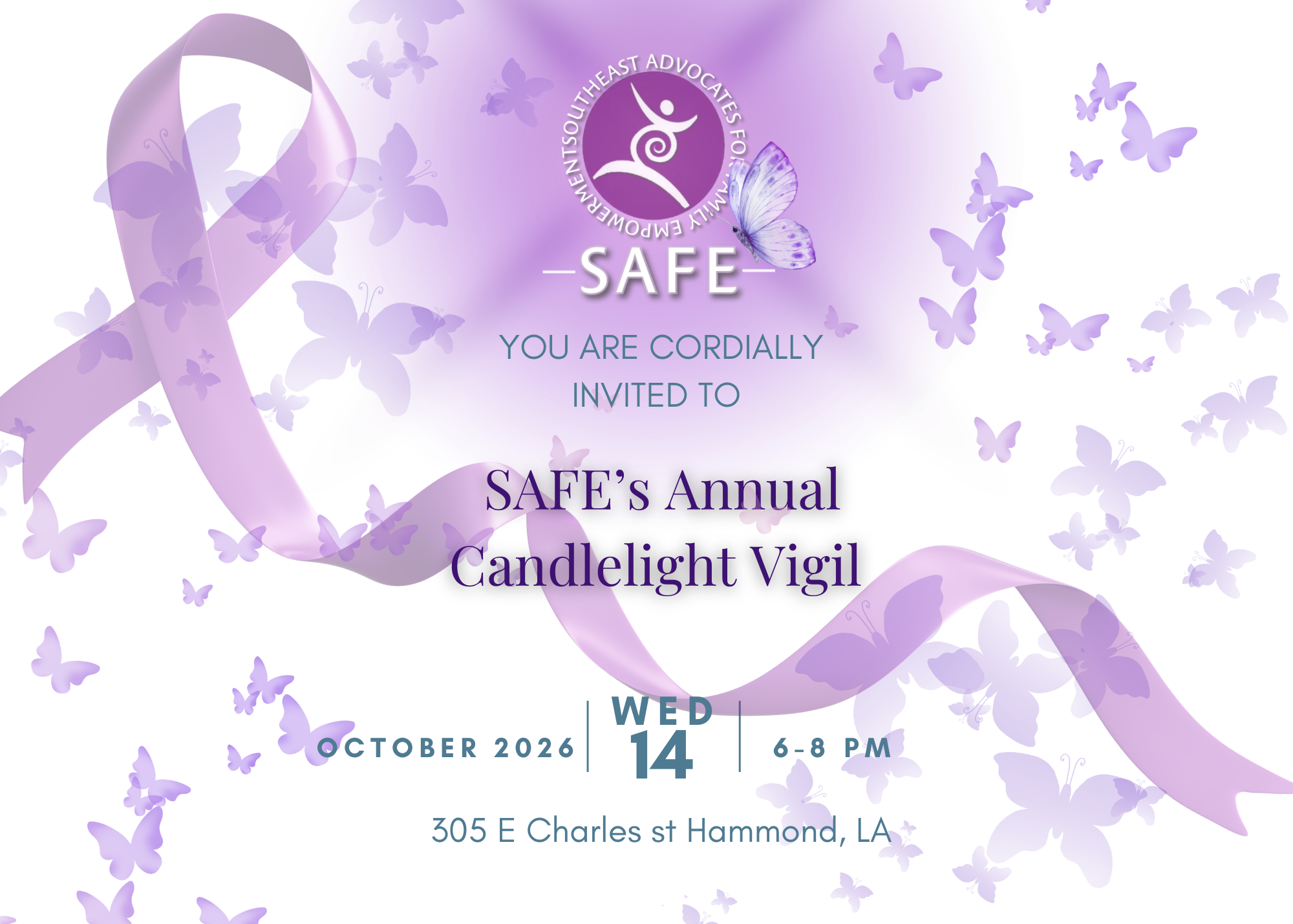
$25+ — Your name or dedication on the Purple Ribbon Wall, unveiled at our Voices of Hope Candlelight Vigil in October
$75+ — Everything above plus a purple yard sign delivered to your home or business in October
$250+ — Gold ribbon with prominent placement plus 2 VIP seats at Voices of Hope
$500+ — Campaign Benefactor with full recognition throughout October
Add your ribbon: givebutter.com/Pbiv04
Donate: www.safelouisiana.org/donate
The Bottom Line
October is one month. Community is every month.
The most powerful thing our community can do for domestic violence survivors isn't wear purple for 31 days.
It's know the signs. Use the right words. Stay present. Connect people to resources. Model healthy relationships. Talk to teenagers before someone else normalizes the wrong things. Give when you're able. Show up when it matters.
That's the power of community. And it starts right now.
985-542-8384
givebutter.com/Pbiv04